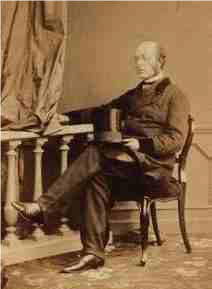
Frederick Edward Hulme (1841-1909) [PLOT 83]

Botanist.

Frederick Hulme was known as a teacher and an amateur botanist. He was the Professor of Freehand and Geometrical Drawing at King’s College London from 1886. His most famous work was Familiar Wildflowers which was issued in nine volumes.

Frederick Edward Hulme was born to Frederick William Hulme and his wife Caroline. He was born in March 1841 in HanleyStaffordshire.

In 1844 his family moved to London where his father taught and worked as a landscape painter. Not only was Hulme’s father an accomplished landscape painter, but his maternal grandmother had also been a painter of porcelain. Hulme attended South Kensington School of Art, which is now called the Royal College of Art.

Hulme became the drawing master at Marlborough College in 1870 and while there he started work on his most famous work. Familiar Wildflowers was issued in parts as not only did it contain a detailed description of each flower but also its medicinal uses and habitat. The major work was the botanical illustration by Hulme of each flower which was recreated as a colour plate in each volume. In his lifetime, Hulme completed nine volumes which were published at intervals.

Hulme was an amateur botanist, antiquarian and natural historian and in 1869 he was elected a Fellow of the Linnean Society. He was drawing master at Marlborough until 1883.

He was the Professor of Freehand and Geometrical Drawing at King’s College London from 1886. Drawing was not part of the standard curriculum at Kings, but as was common in many colleges, students could enroll for an additional course in drawing with Hulme. In the preceding year he had become a lecturer to the Agricultural Association.

Botany seems not to be his only interest as he also published books on heraldry, and on cryptography (Cryptography, the History, Principles, and Practice of Cipher-Writing) – a brief history and an explanation of various techniques of cryptography to his day (end of 19th century).

Hulme died at his home at Kew on 10th April 1909.

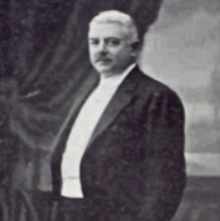
Hugo Hirst (1863-1943) [PLOT 74]

Industrial Engineer and founder of General Electric Company.

Born near Munich, Hugo Hirsch became a naturalized British subject in 1883 and changed his surname to Hirst.

He was co-founder of the General Electric Company plc, and in 1910 became its chairman.

He was created a baronet, of Witton in the County of Warwick, on 2nd July 1925 and elevated to the peerage as Baron Hirst, of Witton in the County of Warwick, on 28th June 1934. Hirst’s eldest daughter Muriel married Leslie Gamage, the elder son of Arthur Walter Gamage, the founder of Gamage’s department store. Leslie joined GEC and became Chairman and Managing Director after Hirst’s death.

As both his son and his grandson died before Hirst, his baronetcy and peerage both became extinct on his death in 1943.

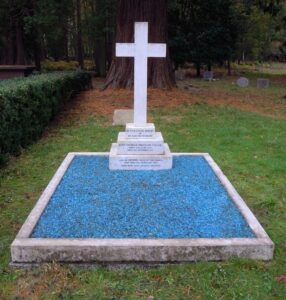
Magdalena Cecilia Colledge (1920-2008) [PLOT 84]

Olympic Skater.

Magdalena Cecilia Colledge born 28th November 1920 was a British figure skater. She was placed eighth in the 1932 Winter Olympic Games at Lake Placid. Aged 11 years and 73 days she competed in the women’s single skating competition and is one of the youngest people to ever compete in the worldwide Olympics Games.

She was the 1936 Olympic silver medallist, the 1937 World Champion, the 1937–1939 European Champion, and a six-time (1935–1939, 1946) British national champion.

Colledge is credited as being the first female skater to perform a double jump, as well as being the inventor of both the camel spin and the layback spin.

Her ashes were buried with her father Lionel and mother, Margaret.

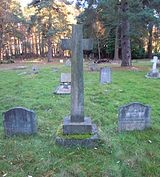
Sir Owen Willans Richardson (1879-1959) [PLOT 8]

Physicist. 

He won the Nobel Prize in Physics in 1928 for his work on thermionic emission, which led to Richardson’s law.

Richardson was born in Dewsbury, Yorkshire, England, the only son of Joshua Henry and Charlotte Maria Richardson. He was educated at Batley Grammar School and Trinity College, Cambridge, where he gained First Class Honours in Natural Sciences. He then got a DSc from University of London in 1904.

After graduating in 1900, he began researching the emission of electricity from hot bodies at the Cavendish Laboratory in Cambridge, and in October 1902 he was made a fellow at Trinity.

In 1901, he demonstrated that the current from a heated wire seemed to depend exponentially on the temperature of the wire with a mathematical form similar to the Arrhenius equation. This became known as Richardson’s law. {\displaystyle s=A\,T^{1/2}\,e^{-b/T}}he H He became a professor at Princeton University from 1906 to 1913, returning to the UK in 1914 to become Wheatstone Professor of Physics at King’s College London, where he was later made director of research. He retired in 1944 and died in 1959.

Richardson married Lilian Wilson, in 1906, and had two sons and a daughter.  Lilian’s death in 1945, he remarried in 1948 to Henriette Rupp, a physicist.

Owen’s son Harold Owen Richardson, specialised in Nuclear Physics and was the chairman of the, Physics Department, Bedford College, London University.

Arthur Stockdale Cope KCVO, RA. (1857–1940) [PLOT 8]

Portrait Painter. 

Cope was born on 2nd November 1857, in South KensingtonLondon. His father was Charles West Cope (1811–1890), a successful history and genre painter, his mother was Charlotte Benning. He attended Norwich Grammar School and Wiesbaden, before training in art at Cary’s Art School and then moving to the Royal Academy school in 1874. He married Emily Beatrix Hawtayne on 6th September 1882, and the couple had two sons and a daughter. In 1927, Cope was appointed Knight Commander of the Royal Victorian Order and in 1933 he became a senior Royal Academician. Cope’s first exhibited a work at the Royal Academy at the age of 19, and went on to establish his own portrait practice, exhibiting 288 works at the Royal Academy and the Royal Society of Portrait Painters between 1876 and 1935. He combined this prolific output with a prestigious roll call of sitters, ranging from Kings Edward VIIGeorge V and Edward VIII, to Kaiser Wilhelm II and the Archbishop of Canterbury.

His high-profile works and successful style won him many honours: in 1900 he became a fellow of the Royal Society of Portrait Painters; in 1910 he was elected Royal Academician; and in 1917 he was knighted. In addition to his busy painting practice, Cope established an art school in South Kensington. He died on 5th July 1940 near Launceston, Cornwall.

Search the Brookwood Cemetery Website

Generic selectors
Exact matches only
Search in title
Search in content
Post Type Selectors
Search in posts
Search in pages