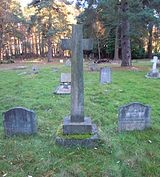
John Thomas Tiller (1854-1925) [PLOT 76]
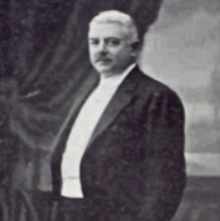
Originator of military precision dancing and the ‘Tiller Girls’.

John Tiller always had a keen interest in music. He was always a perfectionist to the point where very few people could live up to his standards. At ten years old he became a choirboy, and with his perfectionist qualities, he became choirmaster by fourteen.

One of John's uncles, John George Tiller, owned a successful cotton agency and was very wealthy, John’s ambition was for the same lifestyle. His uncle took him into the family business and treated him like a son. During the day John worked in the cotton trade and after work he devoted himself to music and acting. He had a very forceful character and soon progressed to management in the cotton industry and was well known in the local area due to his immense appetite for life.

At 19 his girlfriend, Mary Elizabeth Carr, told him she was pregnant. On Christmas Eve 1873, they married at St John's Parish Church in Manchester. They had 10 children in 11 years. By this time John was a full partner in the cotton business and he was living in a large house like his uncle.

He pursued his theatrical ambitions and became stage manager of an amateur theatrical group made up of local businesspeople who would perform a Minstrels act in Manchester theatres. In 1885 John became director of the Comedy Theatre Manchester and during the same year began teaching children to dance. His early pupils practised for hours every Saturday afternoon amongst the bales of cotton in one of the firm's warehouses. He also taught at his home.

His first dance performances were at small local church dances, and due to his position as director of the Comedy Theatre Manchester he was able to arrange for his small dancers a place in the theatre's Christmas pantomime.

His uncle's son was brought into the family business, and his uncle took to drink and became an alcoholic. John had a huge argument with his uncle that ended in a violent quarrel; John stormed out and set up his own business.

He carried on presenting dancers in an amateur capacity. With this taking up more and more of his time, it made it hard for him to concentrate on making a living in the cotton industry. His real interest was with the theatre and dance. In 1890 John was asked to present a quartet of children for the pantomime Robinson Crusoe at the Prince of Wales Theatre, Liverpool.

He chose four of his best Manchester pupils, all aged about 10 years: Dolly Grey, Tessie Lomax, and twins Cissy and Lilly Smith. They were chosen as they were all the same height and had the same very slender shape with dark hair. He worked with them relentlessly repeating every movement time and time again until they were perfect. He worked them so hard that at times they were exhausted. John was striving for absolute precision in dance. These were the first of thousands of Tiller Girls where every movement had to be perfect and every turn had to be simultaneous. The pantomime lasted for three months with every show generating glowing reports in the newspapers and receiving awards for the girls and their manager. The fee received for this only barely covered expenses and costs. This first experience helped John make up his mind to become a professional manager.

John’s wife Mary died of cancer in 1905, he remarried to Jennie Walker in 1906. Jennie became involved in the running of the Tiller Schools until her death in February 1936.
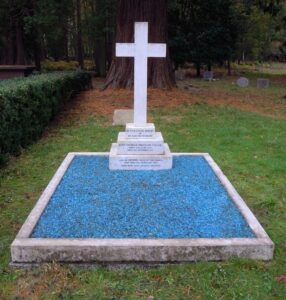
Sir Eustace Henry William Tennyson d’Eyncourt (1868-1951) [PLOT 76]

Naval Architect.

Sir Eustace Henry William Tennyson d'Eyncourt, 1st Baronet KCB FRS born 1st April 1868 was a British naval architect and engineer. As Director of Naval Construction for the Royal Navy, 1912–1924, he was responsible for the design and construction of some of the most famous British warships. He was also chairman of the Landship Committee at the Admiralty, which was responsible for the design and production of the first military tanks to be used in warfare.

Frederick Edward Hulme (1841-1909) [PLOT 83]

Botanist.

Frederick Hulme was known as a teacher and an amateur botanist. He was the Professor of Freehand and Geometrical Drawing at King's College London from 1886. His most famous work was Familiar Wildflowers which was issued in nine volumes.

Frederick Edward Hulme was born to Frederick William Hulme and his wife Caroline. He was born in March 1841 in HanleyStaffordshire.

In 1844 his family moved to London where his father taught and worked as a landscape painter. Not only was Hulme's father an accomplished landscape painter, but his maternal grandmother had also been a painter of porcelain. Hulme attended South Kensington School of Art, which is now called the Royal College of Art.

Hulme became the drawing master at Marlborough College in 1870 and while there he started work on his most famous work. Familiar Wildflowers was issued in parts as not only did it contain a detailed description of each flower but also its medicinal uses and habitat. The major work was the botanical illustration by Hulme of each flower which was recreated as a colour plate in each volume. In his lifetime, Hulme completed nine volumes which were published at intervals.

Hulme was an amateur botanist, antiquarian and natural historian and in 1869 he was elected a Fellow of the Linnean Society. He was drawing master at Marlborough until 1883.

He was the Professor of Freehand and Geometrical Drawing at King's College London from 1886. Drawing was not part of the standard curriculum at Kings, but as was common in many colleges, students could enroll for an additional course in drawing with Hulme. In the preceding year he had become a lecturer to the Agricultural Association.

Botany seems not to be his only interest as he also published books on heraldry, and on cryptography (Cryptography, the History, Principles, and Practice of Cipher-Writing) - a brief history and an explanation of various techniques of cryptography to his day (end of 19th century).

Hulme died at his home at Kew on 10th April 1909.

Hugo Hirst (1863-1943) [PLOT 74]

Industrial Engineer and founder of General Electric Company.

Born near Munich, Hugo Hirsch became a naturalized British subject in 1883 and changed his surname to Hirst.

He was co-founder of the General Electric Company plc, and in 1910 became its chairman.

He was created a baronet, of Witton in the County of Warwick, on 2nd July 1925 and elevated to the peerage as Baron Hirst, of Witton in the County of Warwick, on 28th June 1934. Hirst's eldest daughter Muriel married Leslie Gamage, the elder son of Arthur Walter Gamage, the founder of Gamage’s department store. Leslie joined GEC and became Chairman and Managing Director after Hirst's death.

As both his son and his grandson died before Hirst, his baronetcy and peerage both became extinct on his death in 1943.

Magdalena Cecilia Colledge (1920-2008) [PLOT 84]

Olympic Skater.

Magdalena Cecilia Colledge born 28th November 1920 was a British figure skater. She was placed eighth in the 1932 Winter Olympic Games at Lake Placid. Aged 11 years and 73 days she competed in the women's single skating competition and is one of the youngest people to ever compete in the worldwide Olympics Games.

She was the 1936 Olympic silver medallist, the 1937 World Champion, the 1937–1939 European Champion, and a six-time (1935–1939, 1946) British national champion.

Colledge is credited as being the first female skater to perform a double jump, as well as being the inventor of both the camel spin and the layback spin.

Her ashes were buried with her father Lionel and mother, Margaret.

Search the Brookwood Cemetery Website

Generic selectors
Exact matches only
Search in title
Search in content
Post Type Selectors
Search in posts
Search in pages