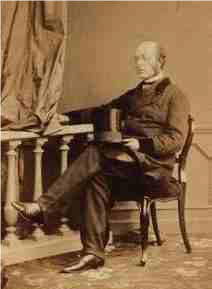
Edward Ballard (1820-1897) [PLOT 36]

Physician and Public Health Officer.

Edward Ballard was a 19th-century English physician, best known for his reports on the unsanitary conditions in which most of Victorian England lived. Ballard was born in Islington, Middlesex, the son Edward George Ballard, the English writer, and Mary Ann Shadgett. He was educated at Islington Proprietary School and at University College, London, from which he received his doctorate in medicine in 1843.

Charles Warne (1802-1887) [PLOT 30]

English antiquarian and archaeologist specialising in prehistoric and ancient monuments of Dorset.

Born in Dorset, with the poet William Barnes he was involved in protecting the Maumbury Rings which resulted in their statutory protection from the route of the proposed Wilts, Somerset and Weymouth Railway Act of 1845. This was the first time an antiquity was saved from being damaged by a proposed train route. Warne published accounts of his archaeological discoveries between 1836 and 1872 many of which were based on his own research and fieldwork. Elected as a Fellow of the Society of Antiquaries of London in 1856, Warne was then and for some time afterwards a resident of London. He researched many of the prehistoric remains of Dorset. For a long time he lived at EwellSurrey moving for the last years of his life to Brighton, where he died on 11th April 1887.

During his lifetime Warne amassed a large collection of English and Roman coins part of which was sold by Messrs. Sotheby, Wilkinson, & Hodge, on 24th and 25th May 1889, two years after his death. Warne's collection of sepulchral urns and other relics from barrows went to the Dorchester Museum.

His grave is designed to resemble a prehistoric barrow with the upright stone being made from serpentinite.

Horatia Nelson Johnson (1832-1890) [PLOT 26]

Horatia Nelson Johnson (1832-1890) [PLOT 26]

Granddaughter of Lord Horatio Nelson.

Horatia Nelson Johnson was the seventh of nine children born to Horatia Nelson (1801-1881), Lord Horatio Nelson's child by Emma Hamilton.

Her father was the Rev. Philip Ward (1795-1859), for many years Vicar of St Mildred's Church in Tenterden, Kent. Horatia married William Johnson (1827-1891) in August 1858, and they lived in London, latterly at 6 Gower Street. They had several children: William Horatio (born 1859), Philip (1861-1948), and Marjorie, who died in infancy. Horatia died in October 1890, and William died in the following March.

Field Marshal Sir William Robert Robertson (1860-1933) [PLOT 28]

Sir William Robert Robertson, 1st Baronet, GCBGCMGGCVODSO. Born 29th January 1860  was a British Army officer who served as Chief of the Imperial General Staff (CIGS) – the professional head of the British Army – from 1916 to 1918 during the First World War. As CIGS he was committed to a Western Front strategy focusing on Germany and was against what he saw as peripheral operations on other fronts. While CIGS, Robertson had increasingly poor relations with David Lloyd George, Secretary of State for War and then Prime Minister, and threatened resignation at Lloyd George's attempt to subordinate the British forces to the French Commander-in-Chief, Robert Nivelle. In 1917 Robertson supported the continuation of the Third Battle of Ypres, at odds with Lloyd George's view that Britain's war effort ought to be focused on the other theatres until the arrival of sufficient US troops on the Western Front.

Robertson is the only soldier in the history of the British Army to have risen from an enlisted rank to its highest rank of field marshal.

Admiral Sir Arthur Cummings (1817-1893) [PLOT 35]

Naval Officer.

Sir Arthur Cumming KCB born 6th May 1817 was an officer of the Royal Navy.

He was born in NancyFrance to Sir Henry John Cumming, a general in the British Army and received naval education at the Royal Naval College in Portsmouth. Cumming served as a midshipman in the Mediterranean and North America before being promoted to lieutenant in 1840 for his actions in the Syrian War. He remained with the Mediterranean Fleet until appointed to HMS Frolic, a sloop stationed in South America. Whilst detached from Frolic and in command of a small pinnace on 6th September 1843 Cumming and seven men boarded a Portuguese slave ship, subdued her 27-man crew and brought her back to Rio de Janeiro. He had expected to be promoted for his efforts but was overlooked he resented the decision for the rest of his life. Cumming spent some time in the Navy's Experimental Squadron before being promoted commander on 9th November 1846.

Cumming's first command was HMS Rattler, stationed off West Africa, during which he captured another slave ship. He saw active service against the Russians during the Crimean War, captaining the frigate HMS Gorgon and being promoted to post-captain on 19th April 1854. Subsequently, Cumming was transferred to HMS Conflict and, in company with HMS Amphion, was able to capture the Baltic Sea port of Libau without firing a shot. Towards the end of the war he took command of the ironclad floating battery HMS Glatton but arrived in the Black Sea after the peace had been agreed. He returned to the UK in time for Glatton to take part in Queen Victoria's 1856 Fleet Review. Cumming was appointed captain of the frigate HMS Emerald on 14th May 1859 and remained with the ship until the end of her Royal Navy career on 7th November 1863. Emerald served in the Channel Fleet, the Baltic Sea and Admiralty propeller trials. She also made several trips to the Americas including "one of the quickest passages on record" to Bermuda in 1860. After her decommissioning Cumming was appointed a Companion of the Order of the Bath, served aboard HMS Victory and Duke of Wellington and in the Packet Service.

Cumming achieved flag rank on 27th February 1870 when he was promoted to rear-admiral. He served for a while as a port admiral before becoming the Naval Commander-in-Chief of the East Indies in 1872, remaining there until 1875. Cumming continued to receive promotions, becoming vice-admiral in 1876 and admiral in 1880, he retired from the Navy in 1880. In retirement he lived at Foston Hall, near Derby. Cumming was appointed Knight Commander of the Order of the Bath as part of Queen Victoria's Golden Jubilee celebrations on 21st June 1887 he died in London on 17th February 1893.


Search the Brookwood Cemetery Website

Generic selectors
Exact matches only
Search in title
Search in content
Post Type Selectors
Search in posts
Search in pages