Surrey Day 2025


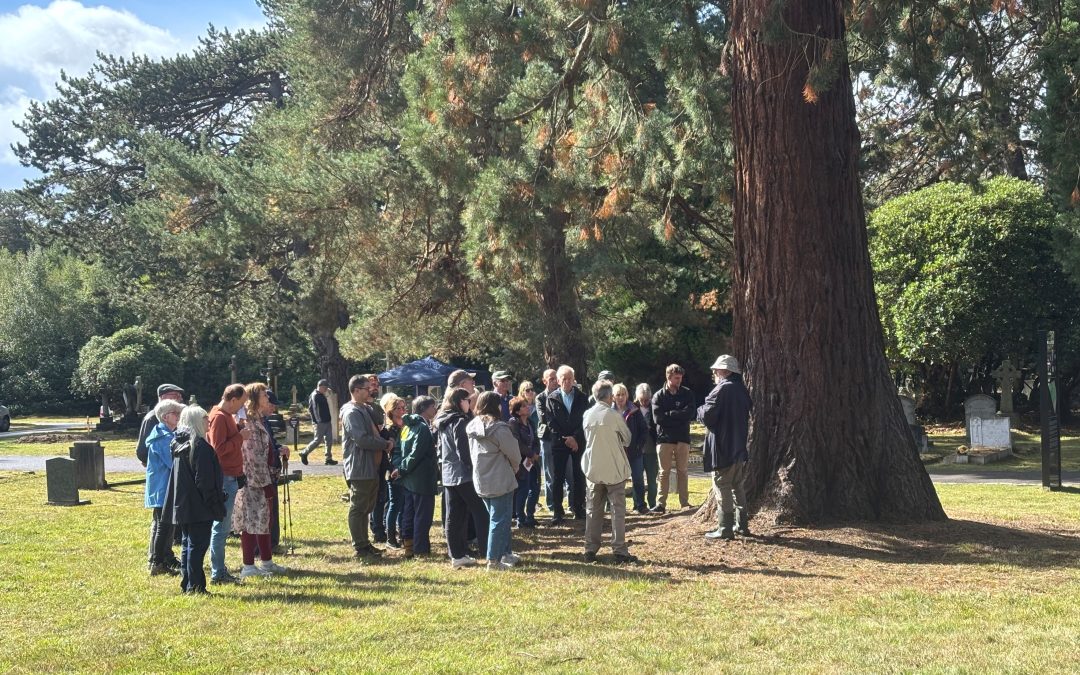
To mark 170 years since its establishment, Brookwood Cemetery will host a celebratory event with walking tours of the cemetery on Surrey Day, Saturday 7 May 2022.
The event will feature information displays and members of the Brookwood Cemetery Society will be available to answer questions about the cemetery and help locate graves on the site. Guided walks of the site will include an introduction to the cemetery and a look inside some of the mausoleums and at the beautiful wildlife. The event will also mark 30 years of the Brookwood Cemetery Society.
Established through an Act of Parliament in 1852, Brookwood Cemetery (apart from the northern section) opened to the public on 13 November 1854 when the first burials took place. The cemetery is a Grade I listed park and garden and, at 220 acres, is one of the largest cemeteries in Western Europe.
As part of the ongoing restoration of Brookwood Cemetery, in 2021 Woking Borough Council remediated 7,000 cubic metres of contaminated land within the cemetery to create a beautiful new burial site and wetland area. This will accommodate 480 new burial plots, primarily for use in Muslim burials.

Woking’s Brookwood Cemetery, a Historic England significant heritage destination, has once again received the National Green Flag Award status.
The award scheme, managed by the leading environmental charity Keep Britain Tidy under licence from the Ministry of Housing, Communities and Local Government, recognises and rewards well-managed parks and green spaces, setting the benchmark standard for their management across the United Kingdom and around the world. The purpose is to promote the need to have access to quality green space and enable residents live a healthier lifestyle.
In recent months, as part of the ongoing restoration of Brookwood Cemetery, Woking Borough Council has remediated 7,000 cubic metres of contaminated land within the grounds to create a beautiful new burial site and wetland area.
Cllr Kevin Davis, Woking Borough Council’s lead member for Brookwood Cemetery, said: “Brookwood Cemetery is a site like no other. The natural beauty, history and ecological value makes the grounds a unique asset to the community. “Renewing our Green Flag status is a remarkable achievement to be proud of and a testament to the recent restoration works the cemetery has seen. The new features have transformed the area and with the addition of contemplation spots and benches over the wetland, the site welcomes visitors with a renewed warmth and an intimate atmosphere.”
Avril Kirby, Brookwood Cemetery Manager, continued: “The Council is committed to improving the borough’s biodiversity and green infrastructure. It brings me great pride that this prestigious award has once again been honoured, especially after the hard work and dedication from all the teams involved in creating the new burial site, the wider restoration programme and the general upkeep of the site.”

As part of the ongoing restoration of Brookwood Cemetery, Woking Borough Council has remediated 7,000 cubic metres of contaminated land within the cemetery to create a beautiful new burial site and wetland area.
The new five and half acre site within the North Cemetery will be used predominantly for Muslim burials as other sites within the cemetery begin to reach capacity. The new site has space for 480 individual burial plots spread across two grassland areas which are linked by a raised boardwalk complete with contemplation spots and benches looking out onto the wetland.
The mature and established trees on site, some of which date back to the cemetery’s original plantings in 1852, continue to play a pivotal role in the design providing cover for the meandering pathways that connect to the boardwalk. New planting includes a number of unusual ornamental tree and shrub species that resonate with the cemetery’s Victorian design, along with native shrubs and wildflower.
Speaking about the works, Ian Tomes, Woking Borough Council’s Asset Manager, said: “It has taken us three years to remediate the land which was used by the previous owners as an illegal tip site. The original enforcement noticed served by Surrey County Council required the removal of all of the dumped material but with the help of property and construction consultants, Synergy LLP, and landscaping architects, Terra Firma Consultancy Ltd, we’ve been able to screen the material on site and use it to form two grass covered mounds, the tops of which will be used for internments.
“The creation of a wetland has enabled us to turn the site’s complex hydrology into a feature. The boardwalk design takes into account the site’s fluctuating water levels, and we’ve added marginal aquatic planting to enhance the appearance of the wetland.”
As well as the provision of good quality grave space and environmental improvements, the £800,000 project also capitalised on some of the cemetery’s historical features, supporting the council’s aim of transforming Brookwood Cemetery into a major heritage destination. Ian Tomes explained: “We had to widen the main entrance of the North Cemetery to get vehicles and machinery on and off site so we used this opportunity not only to improve the appearance of the main entrance but also to make reference the cemetery’s historic railway.
“Feature paving, which forms part of the new road surface, mimics the tracks of the London Necropolis Railway that brought Victorian mourners and the deceased to Brookwood. The tree lined route which the trains took has been emphasised by the new ‘tracks’ making it much easier for visitors to identify and appreciate.”
A small tree planting ceremony involving the Mayor of Woking, members of the Brookwood Cemetery team and representatives from each of the specialist contractors took place on Monday 20 September to the mark the completion of the project.
Addressing the group, the Mayor of Woking, Cllr Liam Lyons, said: “This wonderful new wetland and burial area will further enhance one of the borough’s greatest historic assets. I congratulate you all for your efforts and think you’ve done an amazing job, not only in returning this part of cemetery back to public use but also in transforming it into a beautiful, nurturing space that will support the grieving or anyone looking to find comfort in nature and the outdoors. Well done all.”
Woking Borough Council’s Lead Member for Brookwood Cemetery, Cllr Kevin Davis, said: “In July 2020, the Council approved the Brookwood Cemetery Masterplan and Experience Plan which set out a number of broad policies by which the site will be managed and developed in the future. They support a vision of a sustainable working cemetery leading the way in heritage conservation which other sites will look to. I think these latest works are a really good example of how we intend to improve the site while also retaining and enhancing all the special features that make Brookwood Cemetery so unique.

Daniel Solander 1733 – 1782 (pictured on the right)
Swedish botanist [Plot 122 Swedish Church Ground]. Solander was born in Piteå/Öjebyn in the north of Sweden. At the age of
17, he commenced studies at Uppsala University for the famous botanist Carl von Linné. Solander was one of Linné’s disciples in working on the book Systema Naturae. In Systema Naturae, Linné outlined his ideas for the hierarchical classification of the natural world.
In 1760, Solander arrived in London as English scientists had long requested for one of LInné’s disciples to come to England and share knowledge about Linné’s new classification system and this fell on Solander. He soon learned English and established himself in England. In 1762, he declined a professorship in St Petersburg, in favour of cataloguing the natural history specimens at the British Museum and he became the keeper of the natural history collections at the British Museum in 1773.
Solander made lots of influential friends, one of whom was Sir Joseph Banks and Solander travelled together with him on the voyage of Captain James Cook on the HMB Endeavour to Australia, New Zealand and the South Pacific 1768-1771. Solander and Banks returned to London as heroes, they were the sought after celebrities of the day and botanists from all
over the world came to see them.
Solander became a British citizen and continued living in London until his death in 1782.