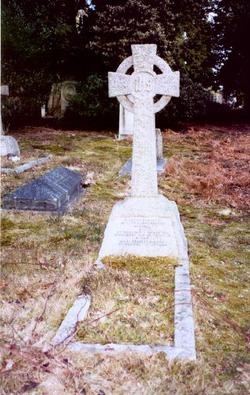
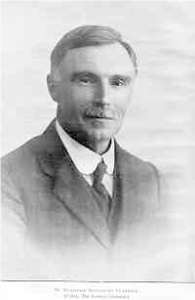
Bennet Graham Burleigh (1840-1914) [PLOT105]

Journalist.

Born in Glasgow, he began work as a shipping clerk at the age of 20. Shortly afterwards, he was forced to marry one of the family's servants after getting her pregnant. Burley left for North America with another clerk to take part in the American Civil War. He joined the Confederates, disrupting Union ship traffic. Burley was captured in May 1864 but escaped a month later. He took part in a raid on Lake Erie in September 1864. Burley had convinced a Canadian cousin in Guelph, to manufacture munitions for use in that raid. He returned to Guelph but was later captured and extradited to the United States. The jury deadlocked at his first trial and he was returned to jail to await a second trial. Burley was able to escape to Canada and returned to Scotland. At this point, he changed his name to Bennet Burleigh.

In 1881, he was hired by the London Telegraph to cover the war in Sudan. He was a correspondent for the Central News Agency during the bombardment of Alexandria in 1882. Burleigh was the first to report the failure of the Gordon relief expedition, which led to the slaughter of the Khartoum garrison. He also covered the Boer War and the Russo-Japanese War. He authored several books on his experiences reporting on conflicts. Burleigh ran unsuccessfully several times for Glasgow seats in the British parliament. He died in Bexhill on June 17, 1914. Burleigh is thought by some to be a model for the correspondent Gilbert Torpenhow in Rudyard Kipling's The Light that Failed.

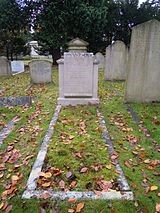
SIR JAMES BRUNLEES (1816-1892) [PLOT 105]

Civil Engineer.
James was born in Kelso on 5th January 1816. He was sent to school at the age of six were he excelled in arithmetic and elementary mensuration. His father removed him from school when he was twelve and set him to work with him on the estate of Broomlands Farm, with the idea of James becoming a landscape gardener.

A chance meeting with Mr Alexander Adie who was surveying the grounds and being allowed to assist him made James realise he wished to be an engineer. This he did and worked on many landmark constructions, a scheme for the Channel Tunnel was one. In 1886 he received a knighthood. He died at his home in Wimbledon on 2nd June 1892 and is buried with his family.

Alfred Edmeades Bestall MBE (1892-1985) [PLOT 100]

Rupert Bear Cartoon Illustrator.

Invited to take over the "Rupert Bear" strip in 1935 when its originator, Mary Tourtel, had to retire due to failing eyesight, he developed and wrote over 270 Rupert adventures, and remained the regular artist and author until his official retirement in 1965. He introduced new characters, the Rupert Bear annuals, and ensured that Rupert and his friends always behaved correctly. He continued to contribute material up to 1982.

William Henry Quilliam (1856-1932) [MUHAMMADAN PLOT] Unmarked Grave


Lawyer and prominent Muslim leader.

William changed his name to Abdullah Quilliam and later Henri Marcel Leon or Haroun Mustapha Leon, he was a 19th-century convert from Christianity to Islam, noted for founding England's first mosque and Islamic centre.

Muhammad Marmaduke William Pickthall (1875-1936) [MUHAMMADAN PLOT]

Novelist who also translated the Qur’an into English.

His translation of the Qur'an is one of the most widely known and used in the English-speaking world. A convert from Christianity, Pickthall was a novelist, esteemed by D. H. Lawrence, H. G. Wells, and E. M. Forster, as well as a journalist, headmaster, and political and religious leader. He declared his conversion to Islam in dramatic fashion after delivering a talk on 'Islam and Progress' on 29 November 1917, to the Muslim Literary Society in Notting Hill, West London.

Search the Brookwood Cemetery Website

Generic selectors
Exact matches only
Search in title
Search in content
Post Type Selectors
Search in posts
Search in pages