Ramadan Guney (1932-2006) [Plot M3]

Ramadan Huseyin Guney was born in Cyprus in 1932. After leaving school, he served in the British army and police on the island. In 1958 he emigrated to Britain and set up a music publishing business which continues to sell recordings of ethnic music to the Turkish communities in London. He helped found and run the first Turkish Cypriot Mosque in London, and worked on a variety of social and community projects, arising from his work with the UK Turkish Islamic Centre.

Mr Guney’s ownership of the cemetery was initially contentious but ultimately successful. He cleared some areas of trees and undergrowth, partly to correct the problem of a rising water table (which was causing areas to flood), and partly to create new burial space. Brookwood was never designed to be the dense woodland it reverted to in places due to the years of neglect by previous owners, who had sold off land under the terms of the 1975 Brookwood Cemetery Act. Profits from these land sales were meant to be reserved for restoration purposes, but this never happened.

Mr Guney’s maintenance programme was a slow and frustrating process, and was undertaken without any external funding support whatsoever. It included the restoration of the Muslim and Catholic sections (where the majority of burials are now taking place), whilst working on key areas of the wider cemetery as funding and staffing levels allowed. He also undertook the digitization of the burial records.

Mr Guney’s vision for Brookwood Cemetery was to recreate its beautiful park-like setting. The highlight of Mr Guney’s ownership was undoubtedly the special celebration he arranged for the 150th anniversary of the cemetery. This took place on 5th September 2004. Attended by over 100 guests from around the world, it was a truly multicultural celebration. At the same time Mr Guney launched his own restoration fund for the cemetery he owned, admired and loved.

His vision remains unfinished. Two major projects now left in the planning stages include the restoration of the lake in the Glades of Remembrance, and the restoration of selected mausoleums. His 1994 comment that “Brookwood Cemetery is safe … as long as I live” is as true now as it was then.

Mr Guney had 2 sons and 4 daughters with Suheyla, who passed away in 1992. All of his children survive him. Following a service at his Mosque in London, Mr Guney was buried in a vault at Brookwood on the evening of Friday 10th November.

John Singer Sargent (1856-1925)

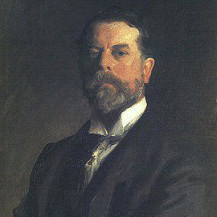
A self portrait of John Singer Sargent is shown above.

John Singer Sargent is one of several famous artists buried at Brookwood who have an entry in the Dictionary of National Biography. An American artist, who spent most of his life in London. Sargent began his training in Paris and exhibited there from 1877. He moved to England in 1884 and his early years in this country show his “impressionistic” style.

From the late 1880s he established himself as a portrait painter, and has been described as the most fashionable portrait artist since Sir Thomas Lawrence. In the early 1900s he tired of “paughtraiture” and concentrated on landscapes, charcoal sketches, watercolors, and the decoration of the Boston Public Library.

He served briefly as an official war artist in 1918.

Sargent is buried in plot 35 (the “Ring”).

Portland stone. An upright grave-marker, based on an Attic stele, inscribed at top ‘LABORARE EST ORARE’, and at the foot ‘HE GIVETH HIS BELOVED SLEEP’.

The following links give further information about John Singer Sargent:

Wikipedia entry for John Singer Sargent
Sargent Virtual Gallery

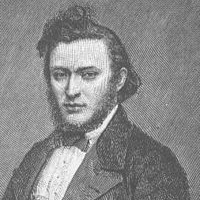
John Lynch – (c1832-1866)

John Lynch was a widower and publican who lodged in Cork City and became involved with the Cork City Fenians. He was convicted on the word of an informer, John Warner, who stated that Lynch was a colonel in the Fenian organisation in Cork. Lynch was convicted of treason and felony by Judge Keogh in December 1865. Overall the evidence used to convict Lynch was rather weak for the sentence of 10 years penal servitude.

Lynch was sent first to Pentonville Prison. Later in December 1865, due to a chest infection, he was moved to the hospital in Woking Prison. Other inmates at Woking included Jeremiah O’Donovan Rossa, Captain Richard O’Sullivan Burke (retired from the US army), Captain Timothy Deasy (of the 9th Massachusetts Infantry Volunteers), Brian Dillon (a law clerk from Cork), and Charles Kickham (author of the popular novel Knocknagow).

Evidence of Lynch’s imprisonment at Woking comes via a number of letters smuggled out of the prison that were subsequently published by Jenny Marx in the French newspaper La Marseillaise under the pseudonym “J. Williams”. Lynch succumbed to the regime of Woking Prison and died there on 2 June 1866.

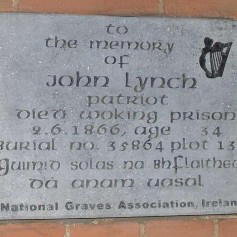
He was subsequently buried in the Roman Catholic pauper section of Brookwood Cemetery on 6 June. The precise location of this area and his grave are unknown, but it is somewhere in the woodland beyond plot 134. In memory, a stone plaque memorial is sited on the chapel wall – Plot 124

The National Graves Association of Ireland commissioned a stone plaque which was fixed to the wall of the former Catholic chapel in 2004. Prior to this, Lynch’s only other memorial was on the National Monument on the Grand Parade in Cork City. The monument commemorates all Irish patriots who died during the period 1798-1867.

Gottleib Leitner (1840-1899)

Gottleib Leitner (1840-1899)

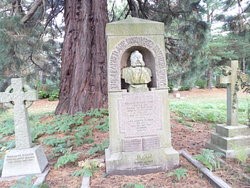
Memorial to Dr Gottlieb William Leitner (1840-1899).Carrara bust within a pink granite surround. Mason unknown. Leitner's bewhiskered bust is set within a curved niche: around it, in raised letters, is the inscription THE LEARNED ARE HONOURED IN THEIR WORK.Dr Gottlieb Wilhelm Leitner was responsible for making Woking a major centre for Islam in Britain. He is one of several famous people buried at Brookwood who have an entry in the Dictionary of National Biography. A noted linguist and academic, he founded over 80 institutions in India and elsewhere, including the University of Lahore. In 1884 Dr Leitner founded the Oriental Institute in Woking. This was designed to become a European centre for the study of oriental culture, history and languages.

In the late 1890s the Oriental Institute began awarding degrees under the auspices of the University of Lahore, but it closed for ever in the summer following Dr Leitner's death. Two reminders of the Oriental Institute survive in Woking: the Mosque and Oriental Road, named after the Institute.

Dr Leitner is buried in plot 2.

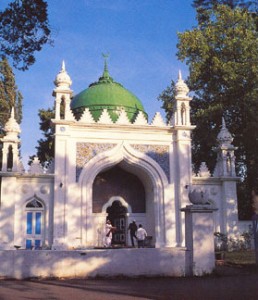
The Woking (or Shah Jehan) Mosque is shown in the image to the right. It was designed by the architect W.I. Chambers and opened in 1889.

The following links give further information about Dr Leitner:

Woking Muslim Mission article on Dr Leitner
Wikipedia entry for Dr Leitner
Some of Dr Leitner's articles on Islam

Edith Thompson (1893-1923)

Edith Thompson was a housewife and milliner. She was executed on 9 January 1923 because her lover, Frederick Bywaters, murdered her husband Percy. She has an entry in the Dictionary of National Biography.

Their trial took place between 6-11 December 1922. Both were found guilty, the Crown "proving" her complicity through her surviving love letters to Frederick Bywaters. Innocent of murder, Mrs. Thompson was hanged for adultery.

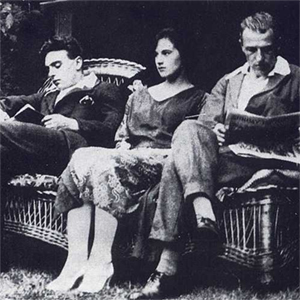
Edith and Percy Thompson are pictured in the image to the left, dated September 1922. Both were hanged at the same time on the morning of 9 January 1923, she at Holloway and then at Pentonville. Her permanent memorial in plot 117 was placed there in October 1993 by a number of interested parties.

Originally buried in the burial ground at Holloway Prison, her remains were removed to Brookwood (along with three other women executed at Holloway between 1903 and 1954) in 1971. The removal was necessary due to the complete rebuilding of the prison. Edith Thompson's remains were exhumed from Brookwood Cemetery on 20th November 2018 and taken to the City of London Cemetery where she was reburied in a family grave.

The following links give further information about Edith Thompson:

Wikipedia entry for Edith Thompson
Criminal Justice: The True Story of Edith Thompson by Rene Weis
"Another Life" – a film about Mrs Thompson's life, and a video clip from the film

Search the Brookwood Cemetery Website

Generic selectors
Exact matches only
Search in title
Search in content
Post Type Selectors
Search in posts
Search in pages