A lost Victorian chapel, discovered in the undergrowth at Brookwood Cemetery, has been fully restored by Woking Borough Council. The exquisitely sculpted, Gothic style chapel, built almost entirely from Bath stone, has been sympathetically restored over the past five months using original materials and specialists’ tradespeople.
Built in 1858, the cemetery chapel was adopted by the Colquhoun’s as their family mausoleum. It was restored in 1924 by Violette Freeman in memory of Eliza Colquhoun Redhouse but subsequently left to disappear behind a thick wall of shrubs and rhododendrons.
The council acquired Brookwood Cemetery in 2014 but the chapel remained cocooned in the dense undergrowth for a further two years.
Woking Borough Council’s Strategic Asset Manager, Ian Tomes, explains:
“Brookwood Cemetery is the largest cemetery in the country and of great historical value. When the council bought the 220 acre site in 2014, it was with a view to restoring this Grade 1 listed park and garden to its former glory. “It was through reviewing historical images of the cemetery that we learnt of the existence of the chapel and set about trying to locate it.”
After a concerted effort, the chapel was found in the back woods, in a poor state of repair. The entrance had been crudely blocked up, the floor of the crypt had fallen in and the wrought iron perimeter fencing had either collapsed or rotted. Nonetheless, the chapel’s beauty and character was still evident.
With support from a specialist conservation surveyor and building company, restoration work started in April 2019. Ten coffins were removed from the chapel and placed in storage while the crypt was rebuilt. Major repairs were made to the roof which included replacing the finials and other decorative features that were carved on site by experienced stonemasons. Internally the chapel was re-plastered, and all the iron fixtures and railings were restored in wrought iron by a blacksmith. The stonework and marble cladding was cleaned, and pathways built to give access to the chapel.
Ian Tomes continued:
“In four years, we have transformed the cemetery and hope to restore many of the memorials and structures on site. Colquhoun Chapel is among the first because it is one of the more beautiful buildings in the cemetery, and one of the oldest. What makes it even more special is the fact that it was a lost building, that hadn’t been seen by anyone for a number of years. There’s a wealth of history within the cemetery walls, which we’re trying to make people more aware of while at the same time, making this fantastic space more accessible to the public.”
Brookwood Cemetery was founded in 1852 to house London’s dead and was uniquely serviced by its own railway. In the early 20th Century, part of the site was sold to the Commonwealth War Graves Commission to accommodate the graves of the Commonwealth victims of the First World War. A separate area was also allocated to the American Battle Monuments Commission for American victims.
Twelve Victoria Cross recipients rest within the confines of the cemetery and a further three are commemorated on site.
The cemetery’s immense scale, landscaping, woodland areas and popularity among different denominations, faiths, nationalities, and groups only heighten the site’s historical, cultural, social and nature significance.
“Decades of neglect earned Brookwood Cemetery a place on Historic England’s ‘At Risk Register’ but since acquiring the site we’ve been working to turn that around. “The restoration of Colquhoun Chapel is exciting because it shows what can be achieved and it is now a shining example of the rich history and architectural wonders within the cemetery.
“Brookwood was one of the premier cemeteries in the country and has the potential to be a jewel in Woking’s crown. It’s an important part of our story so it’s down to us to help people understand its value and look after it for future generations.
Built in 1858, the gothic revival style Mausoleum stands in the backwoods of Brookwood Cemetery, Plot 57 and was originally built as a cemetery mortuary chapel. The architect was John Johnson and the sculptural decoration was carried out by W Boulton.
The Mortuary Chapel is built entirely of bath stone; the roof is of stone, carried on arches. Internally the sides are divided into compartments by slate slabs for coffins. The structure includes fantastically fine carved figures of knights in armour on the exterior gable ends. The chapel was adopted by the Colquhoun’s as their family mausoleum before it was completed in 1858. The structure was last restored in 1924 by Violette Freeman in memory of Eliza Colquhoun Redhouse.
For years the Chapel remained cocooned within a wealth of overgrowth and was uncovered in 2016 to expose its splendid character.
The chapel was used for filming an episode of ITV’s Endeavour in November 2017. The crude blockage to the entrance of the chapel was removed, the original doors re-hung, and a temporary false floor installed where the concrete flooring had given way to the crypt.
As considered one of Brookwood Cemetery’s “Jewel in the Crown” a programme of works have been approved for restoration. The Chapel has been inspected and a schedule of repairs and refurbishment work has been provided by Priory Heritage Ltd and we have appointed a specialist company, Sally Strachey Historic Conservation, to carry out these works. The work is very much of a specialist nature and will include masonry repairs, internal works, drainage to the crypt and a pathway from the main roadside.
The intention is that upon completion, the Chapel will be brought back to its former beauty and be appreciated by visitors for many years to come.
Please Note. The roadway at the end of St Marks Avenue will be closed to parking during the period of works.
Author. She was the second daughter of Amir Ali Haidar who was Grand Sharif of Makkah and Isabel Dunn. It is claimed the Princess and her father are direct descendants of the Prophet Muhammad.
She was born in Chamlujah Istanbul. The family came to England where she met and married Major Francis Stewart Fripp. She is the author of two books titled Arabesque: an account of Harem Life describing her life as a Makkah Princess, and Dawn Beyond the Tamarisks. Princess Musbah died in 1977 and lies beside her husband.
Richard Ansdell was a British painter of animals and genre scenes. Ansdell was born on 11 May 1815 in Liverpool (then in Lancashire), the son of Thomas Griffiths Ansdell, a ships’ pulley block maker at Liverpool docks and Anne Jackson. His father died young and Richard was briefly educated at The Liverpool Blue Coat school for orphans. He had a natural talent for art from an early age, and after leaving school worked as an apprentice to a silhouette painter in Chatham in Kent, and also spent time as a sign writer with a travelling circus in the Netherlands.
He first exhibited at the Liverpool Academy in 1835, becoming the President in 1845. His animal and sporting subjects proved to be popular and he soon attracted wealthy patrons. His first exhibition at the Royal Academy, London, was in 1840, with two paintings called “Grouse Shooting” and “A Galloway Farm”. (this painting was bought by the Marquis of Bute and can still be seen at Mount Stewart on the Isle of Bute) This was followed, in 1841 by “The Earl of Sefton and Party Returning from Hunting”, in 1842 “The Death of Sir William Lambton at the Battle of Marston Moor“, (Harris Museum, Preston) in 1843 “The Death” and in 1844 “Mary Queen of Scots returning from the Chase to Stirling Castle”. He went on to exhibit pictures every year at the Academy until 1885 (149 canvases in all). In 1846 he exhibited his first picture, “A Drover’s Halt” at the British Institution, London, and went on to show 30 canvases there.
In June 1841, he married Maria Romer – the couple went on to have 11 children. In 1847 the family left Lancashire to live in Kensington in London. They also had a house called Collingwood Tower at Farnborough and a large Scottish lodge (Moy Lodge) on the banks of Loch Laggan.
In 1850, Ansdell sometimes collaborated on pictures with Thomas Creswick RA, who specialised in landscapes (e.g.: “The South Downs”, “England’s Day in the Country” etc.). He also worked with William Powell Frith RA (“The Keeper’s Daughter”) and John Phillip RA, with whom he travelled to Spain in 1856 and painted a series of Spanish subjects – “The Water Carrier”, “The Road to Seville”, (Fylde Borough Council’s Art Collection) “The Spanish Shepherd” etc. He returned to Spain alone the following year to paint more pictures there.
He was also known for his magnificent and large depictions of important gatherings, depicting each person in the crowd individually. “The Country Meet of the Royal Agricultural Society” (Royal Agricultural Society, Stoneleigh, Warwickshire) and “The Waterloo Cup” (Walker Art Gallery, Liverpool) to name a couple. One of his masterpieces “The Fight for the Standard at the Battle of Waterloo” can be seen today in The Great Hall of Edinburgh Castle.
In 1855, Andsell was awarded a gold medal at the Paris Exhibition for his works, “The Wolf Slayer” and “Turning the Drove”. He also won the “Heywood Medal” three times for his work at the Manchester Royal Institution. He was elected an Associate of the Royal Academy (ARA) in 1861 and a Royal Academician (RA) in 1870.
His first family home was at Lytham St Anne’s, in the borough of Fylde, where a district, “Ansdell”, is named after him. He is the only English artist to have been honoured in this way.
Ansdell died at “Collingwood Tower” at Farnborough in Hampshire on 20 April 1885. He was buried at Brookwood Cemetery Grave No 98363 Plot 30 together with his wife, Maria and two of their children – Harry Blair Ansdell and Rosalie Leech. Rosalie Leech is also buried with her husband William Leech and their son, Guy Ansdell Leech. William Leech was a Lancashire mill owner – his mill was featured in Mary Gaskell’s “North and South” (Mary Gaskell was a family friend). William Leech was a relative to Beatrix Potter.
For more information you can visit a dedicated website HERE.

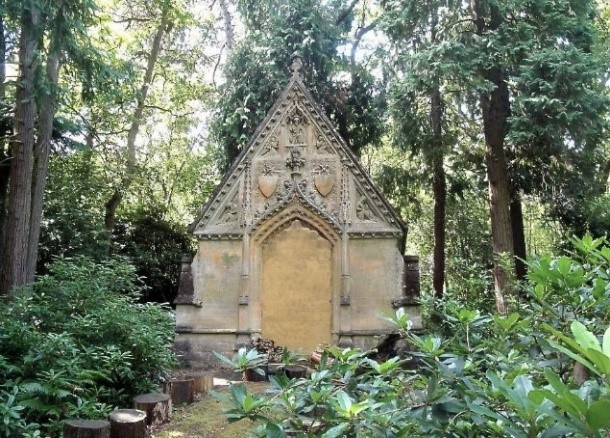
 A lost Victorian chapel, discovered in the undergrowth at Brookwood Cemetery, has been fully restored by Woking Borough Council. The exquisitely sculpted, Gothic style chapel, built almost entirely from Bath stone, has been sympathetically restored over the past five months using original materials and specialists’ tradespeople.
 With support from a specialist conservation surveyor and building company, restoration work started in April 2019. Ten coffins were removed from the chapel and placed in storage while the crypt was rebuilt. Major repairs were made to the roof which included replacing the finials and other decorative features that were carved on site by experienced stonemasons. Internally the chapel was re-plastered, and all the iron fixtures and railings were restored in wrought iron by a blacksmith. The stonework and marble cladding was cleaned, and pathways built to give access to the chapel.
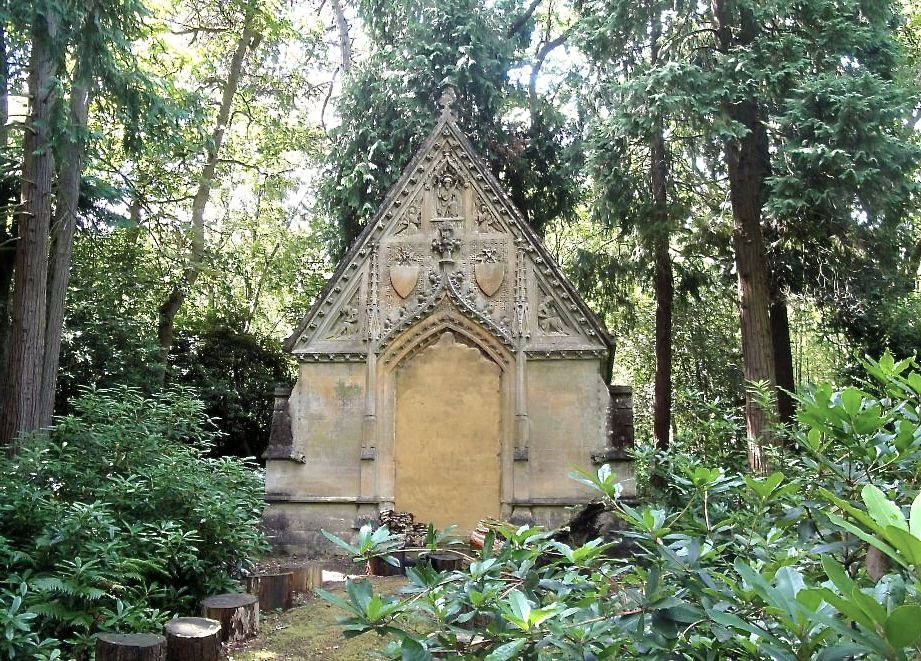
 The Mortuary Chapel is built entirely of bath stone; the roof is of stone, carried on arches. Internally the sides are divided into compartments by slate slabs for coffins. The structure includes fantastically fine carved figures of knights in armour on the exterior gable ends. The chapel was adopted by the Colquhoun’s as their family mausoleum before it was completed in 1858. The structure was last restored in 1924 by Violette Freeman in memory of Eliza Colquhoun Redhouse.
 She was the second daughter of Amir Ali Haidar who was Grand Sharif of Makkah and Isabel Dunn. It is claimed the Princess and her father are direct descendants of the Prophet Muhammad.
