Advance notice: Cemetery Pales to close for three days

Advance notice: Cemetery Pales to close for three days

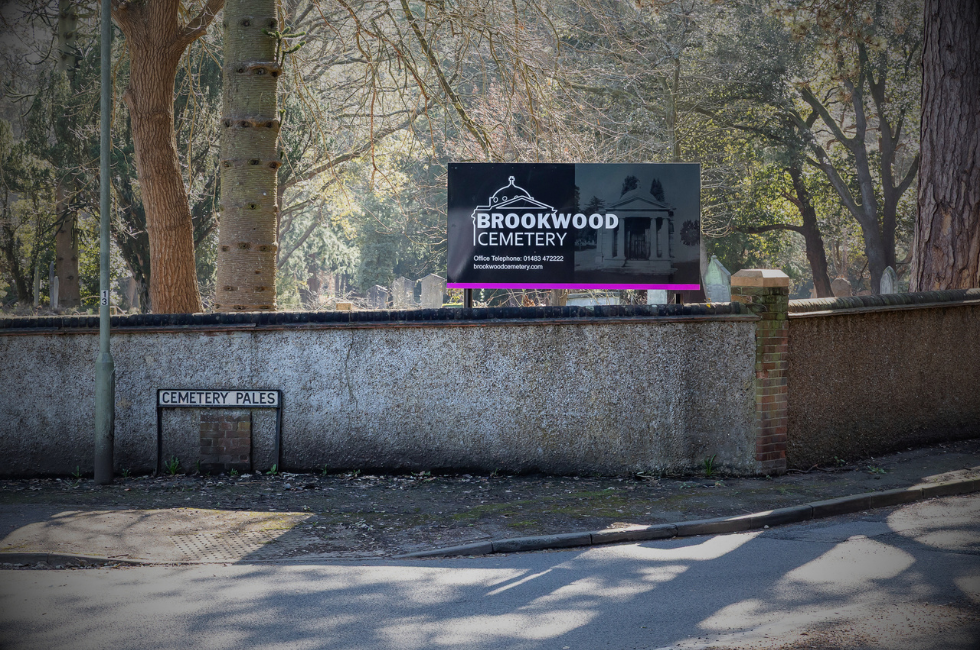
Cemetery Pales will be closed from 11 May for three days, 8am to 5pm. The cemetery will be open as normal. Please ask for access.

Surrey Highways has advised us that it plans to carry out highway works on Cemetery Pales from the 11 May for three days. The works involve the installations of signs, posts and road lines as part of its Rural Road Speed Reduction Scheme.

> Read more about the planned works of the Surrey Highways website

Cemetery Pales will be closed from the junction with Bagshot Road to the borough boundary (where the cemetery walls end). The cemetery will be open as normal. Please ask the highway staff to allow you access.

The work is weather dependent, which may cause delays to either the start or completion dates. Please check the highway information signs for latest information. We will also update this page.

Thank you for your cooperation.

Brookwood cemeteries offer free guided walks to celebrate Surrey Day

Brookwood cemeteries offer free guided walks to celebrate Surrey Day

This Surrey Day (9 May), spend the day discovering what hidden treasures lie behind the walls of Brookwood’s military and civilian cemeteries.

Established in 1852, Brookwood Cemetery is one of Surrey’s most fascinating yet overlooked heritage sites. Within its grounds there are literally thousands of remarkable stories, acres of green space and years of history just waiting to be discovered.

Surrey Day aims to inspire people to explore the wealth of culture and heritage on their doorstep. At Brookwood Cemetery on 9 May, visitors can join a free guided walk, take a self-guided tour of notable graves, picnic in the beautiful grounds and enjoy refreshments provided by The Brookwood Cemetery Society (10am to 3pm).

Avril Kirby, Brookwood Cemetery Manager, said: “By taking part in this countywide initiative we hope to encourage people of all ages to see the cemetery not only as a place of remembrance, but also as a unique green space, a wildlife haven and an important part of Surrey’s story.

“Many people are surprised by just how peaceful, beautiful and full of history the cemetery is. Visitors will be able to wander through our historic grounds, look inside some of our older mausoleums and discover the resting places of notable figures from across centuries.

“We’re very proud to highlight our ongoing conservation work, and the role Brookwood Cemetery continues to play in the life of the county today so we look forward to seeing lots of visitors, new and returning, on Saturday 9 May.”


Programme of activity to celebrate Surrey Day:


  • 10am, free guided walk of the military cemetery (requires booking). Meet at the Canada Building.
  • 1pm, free guided walk of the civilian cemetery (south side). Meet at The Brookwood Cemetery Society lodge.
  • Refreshments at The Brookwood Cemetery Society lodge from 10am to 3pm.
  • Self-guided trails.
  • Designated grass picnic areas near The Brookwood Cemetery Society lodge.
  • A rare peek inside some of our historic mausoleums. Their doors will be open allowing you to see what lies beyond their protective gates.

Monthly guided walks

If you can't make it this time, The Brookwood Cemetery Society offers guided walks on different themes each month.

Five inspirational women buried at Brookwood Cemetery

Five inspirational women buried at Brookwood Cemetery

For International Women’s Day (Sunday 8 March 2026), we spotlight five extraordinary women buried in the cemetery whose legacies continue to inspire.

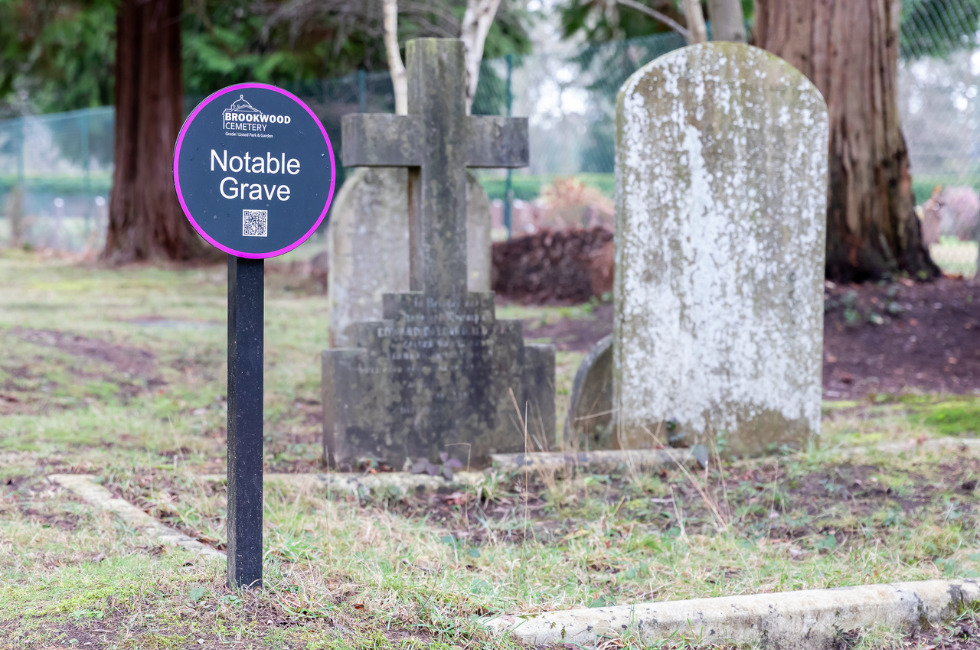
Use our Notable Grave markers to discover their final resting place and learn more about their individual achievements.


Magdalena Cecilia Colledge (1920 to 2008)


Magdalena transformed the world of figure skating through innovation, discipline and boundary breaking talent. A London born prodigy, she became the youngest competitor at the 1932 Winter Olympics at just 11 years old and went on to win Olympic silver in 1936, the World Championship in 1937, and three consecutive European titles from 1937 to 1939. She is credited with inventing iconic elements such as the camel spin and layback spin, and was the first woman to perform a double jump in competition.

Buried in Plot 84, South Cemetery


Joyce Pearce (1915 to 1985)


Joyce was a visionary educator and humanitarian who co founded the Ockenden Venture, one of the earliest UK charities dedicated to supporting refugee children. The initiative began in 1951 when Pearce arranged a holiday for 17 displaced teenagers from post war Europe at her family home in Woking. This small act of compassion blossomed into a major international charity offering education, housing, and welfare support to displaced children worldwide.

Buried in Plot 44, South Cemetery, Woking Ground


Lady Henry Somerset (1851 to 1921)


Lady Henry was a pioneering women’s rights advocate, philanthropist, and leader of the British Women’s Temperance Association. Born into an influential family, she used her position to campaign passionately for women’s welfare, temperance reform, improved social conditions, and later, suffrage.

Buried in Plot 46, South Cemetery


Dame Alicia Frances Jane Lloyd Still

(1869 to 1944)


Dame Alicia was one of Britain’s most influential nursing leaders. A matron at major London hospitals, including St. Thomas’ Hospital, where she also led the Nightingale Training School, she championed professionalism in nursing. Lloyd Still played a crucial role in securing state registration for nurses through the Nurses Registration Act of 1919 and helped establish the first national nursing examination standards.

Her service during World War I as Principal Matron of the No. 5 London General Hospital earned her the Royal Red Cross and later honours such as DBE and CBE. She also co founded the Florence Nightingale Museum and held numerous prominent leadership roles in nursing organisations. Lloyd Still elevated nursing from vocation to respected profession, leaving a legacy that shaped modern healthcare.

Buried in Plot 46, South Cemetery


Dame Rebecca West (1892 to 1983)


Dame Rebecca was a brilliant and versatile writer whose work spanned journalism, fiction, criticism, and political commentary. She first gained attention writing under the pseudonym “Rebecca West” for The Freewoman, and her early biography Henry James (1916) secured her literary reputation.

Throughout her long career, she produced influential novels such as The Return of the Soldier and non-fiction works including Black Lamb and Grey Falcon and A Train of Powder. A passionate supporter of women’s suffrage and an outspoken critic of authoritarianism, West was described by Time magazine in 1947 as “the world’s number one woman writer.” She was honoured with both CBE (1949) and DBE (1959) for her contributions to literature.

Buried in Plot 81, South Cemetery

Guided walks

If you would like to know more about the people buried at Brookwood Cemetery, The Brookwood Cemetery Society runs monthly guided walks.

Partners in Life, Art and Imagination

Partners in Life, Art and Imagination

William and Evelyn De Morgan were a remarkable Victorian couple whose work still feels familiar today, even if you didn’t know their names.  Their lives spanned the late 19th and early 20th centuries, and together they left a legacy of ceramics and paintings that continue to be recognised for their beauty, imagination, and social conscience.

The following article has been researched and written by Hilary Challis.

William De Morgan (1839 to 1917)

William Frend De Morgan was born in London, the son of Augustus De Morgan, a mathematician, and Sophia Elizabeth Frend, a social reformer. Raised in a progressive Victorian household, he was encouraged to pursue art and science. He studied at the Royal Academy but soon grew disillusioned with its rigid approach. A lifelong friendship with William Morris drew him into the Arts and Crafts Movement, which valued craftsmanship and rejected mass industrial production.

De Morgan became best known for his ceramics. His tiles, vases, and dishes were decorated with fantastical birds, fish, and ships, often inspired by medieval and Islamic designs. He experimented tirelessly with glazes, firing techniques, and kiln design, producing lustreware that shimmered with metallic tones. His work was not only decorative but also technically innovative, making him one of the most inventive potters of his generation.

Though ceramics were his main achievement, De Morgan had a second career as a novelist. In later life, after his pottery business closed in 1907, he wrote popular novels such as Joseph Vance and Alice-for-Short. These works were well received at the time, demonstrating his versatility as both artist and storyteller.

Evelyn De Morgan (1855 to 1919)

Mary Evelyn Pickering, later Evelyn De Morgan, was also born in London, into an upper-class family. Her father was a barrister, and her mother came from the Spencer Stanhope family, which included artists and landowners. Evelyn’s uncle, John Roddam Spencer Stanhope, was a painter and an important influence on her career.

She studied at the Slade School of Art, one of the first institutions to admit women on equal terms with men. From the outset, Evelyn defied expectations of her gender and class, choosing to pursue a professional career in painting. Her style was shaped by the Pre-Raphaelite movement, but she developed her own voice, combining allegory, symbolism, and vivid colour.

Her paintings often featured strong female figures and explored themes of spirituality, mythology, and social justice. Works such as Aurora Triumphans and The Gilded Cage conveyed messages about freedom, feminism, and the rejection of material wealth. Evelyn was also deeply opposed to war, and her later paintings reflected her pacifist beliefs.

A Creative Partnership

William and Evelyn married in 1887. Their partnership was both personal and professional, marked by mutual respect and shared ideals. They supported each other’s work, with William’s ceramics and Evelyn’s paintings often displayed together. Both were committed to the Arts and Crafts ethos, valuing beauty, craftsmanship, and moral purpose in art.

Together, they lived through a period of rapid social and industrial change, and their work reflected a desire to offer alternatives to mass production and materialism. Evelyn’s canvases carried allegorical warnings against greed and violence, while William’s ceramics brought imaginative design into everyday homes.

Legacy

William died in 1917, and Evelyn followed two years later in 1919. They lie together; their beautiful Grade II Listed tomb immortalises a married couple, who both achieved lasting artistic success in their own right.

William’s ceramics remain among the most admired decorative arts of the Victorian era, while Evelyn’s paintings continue to resonate with audiences for their beauty and their messages of justice and peace. The couple had no children, and their shared legacy survives entirely through their art.

Evelyn even designed the sculpture for the headstone that marks the couple’s grave (Plot 24).

The grave of William and Evelyn De Morgan.

Today, the De Morgan Foundation, holds collections of both William’s ceramics and Evelyn’s paintings. Their works can also be seen in museums such as the Victoria and Albert Museum and the Guildford-based Watts Gallery Artists Village, which also has a vast online collection to search.

De Morgan Museum in Cannon Hall (Evelyn’s family’s ancestral home in Barnsley) is free to visit.

Images © Trustees of the De Morgan Foundation

A note of thanks

The recent deep clean of the De Morgan memorial was carried out by Steve Davies,
The Military Grave Restorer.

The restoration was made possible thanks to the generous donation of another couple, Jane and Brian Hodson.

They were struck by the beauty and story of the tomb when they visited the cemetery last summer and donated the remaining funds needed to commence the deep clean.

Event notice: Bagh-E-Zehra Cemetery

Event notice: Bagh-E-Zehra Cemetery

On Sunday 8 February 2026, the Bagh-E-Zehra Trust is hosting its annual event in the Bagh-e-Zehra burial ground in the South Cemetery. 

This is a large community event featuring worship and amplified sound starting at 10am. 

Participants are encouraged to park at Brookwood train station and walk through the North Cemetery to access the burial ground. 

Search the Brookwood Cemetery Website

Generic selectors
Exact matches only
Search in title
Search in content
Post Type Selectors
Search in posts
Search in pages