
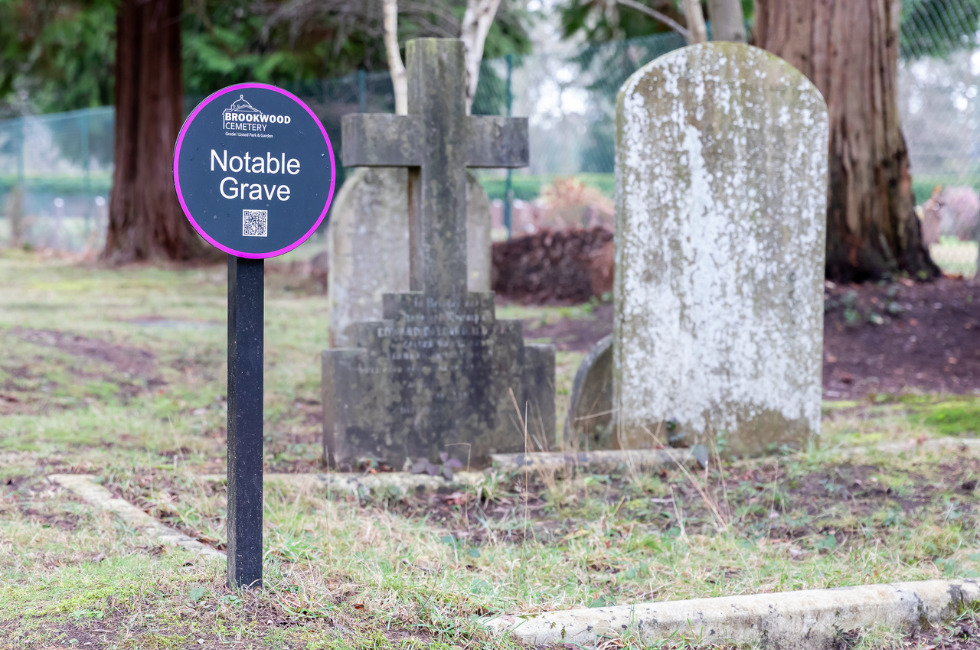
For International Women’s Day (Sunday 8 March 2026), we spotlight five extraordinary women buried in the cemetery whose legacies continue to inspire.
Use our Notable Grave markers to discover their final resting place and learn more about their individual achievements.
Magdalena Cecilia Colledge (1920 to 2008)
Magdalena transformed the world of figure skating through innovation, discipline and boundary breaking talent. A London born prodigy, she became the youngest competitor at the 1932 Winter Olympics at just 11 years old and went on to win Olympic silver in 1936, the World Championship in 1937, and three consecutive European titles from 1937 to 1939. She is credited with inventing iconic elements such as the camel spin and layback spin, and was the first woman to perform a double jump in competition.
Buried in Plot 84, South Cemetery
Joyce Pearce (1915 to 1985)
Joyce was a visionary educator and humanitarian who co founded the Ockenden Venture, one of the earliest UK charities dedicated to supporting refugee children. The initiative began in 1951 when Pearce arranged a holiday for 17 displaced teenagers from post war Europe at her family home in Woking. This small act of compassion blossomed into a major international charity offering education, housing, and welfare support to displaced children worldwide.
Buried in Plot 44, South Cemetery, Woking Ground
Lady Henry Somerset (1851 to 1921)
Lady Henry was a pioneering women’s rights advocate, philanthropist, and leader of the British Women’s Temperance Association. Born into an influential family, she used her position to campaign passionately for women’s welfare, temperance reform, improved social conditions, and later, suffrage.
Buried in Plot 46, South Cemetery
Dame Alicia Frances Jane Lloyd Still
(1869 to 1944)
Dame Alicia was one of Britain’s most influential nursing leaders. A matron at major London hospitals, including St. Thomas’ Hospital, where she also led the Nightingale Training School, she championed professionalism in nursing. Lloyd Still played a crucial role in securing state registration for nurses through the Nurses Registration Act of 1919 and helped establish the first national nursing examination standards.
Her service during World War I as Principal Matron of the No. 5 London General Hospital earned her the Royal Red Cross and later honours such as DBE and CBE. She also co founded the Florence Nightingale Museum and held numerous prominent leadership roles in nursing organisations. Lloyd Still elevated nursing from vocation to respected profession, leaving a legacy that shaped modern healthcare.
Buried in Plot 46, South Cemetery
Dame Rebecca West (1892 to 1983)
Dame Rebecca was a brilliant and versatile writer whose work spanned journalism, fiction, criticism, and political commentary. She first gained attention writing under the pseudonym “Rebecca West” for The Freewoman, and her early biography Henry James (1916) secured her literary reputation.
Throughout her long career, she produced influential novels such as The Return of the Soldier and non-fiction works including Black Lamb and Grey Falcon and A Train of Powder. A passionate supporter of women’s suffrage and an outspoken critic of authoritarianism, West was described by Time magazine in 1947 as “the world’s number one woman writer.” She was honoured with both CBE (1949) and DBE (1959) for her contributions to literature.
Buried in Plot 81, South Cemetery
Guided walks
If you would like to know more about the people buried at Brookwood Cemetery, The Brookwood Cemetery Society runs monthly guided walks.